Su 24 Fencer - The lead section of this article may be shortened to adequately summarize the main points. Please consider expanding the lead so that all important aspects of the article are accessible. (June 2022)
The Sukhoi Su-24 (NATO reporting name Fcer) is a supersonic, all-weather attack aircraft developed in the Soviet Union. The aircraft has a variable wing, twin gins and side seats arranged for two crew. It was the first aircraft of the USSR to support an integrated digital navigation system.
Su 24 Fencer
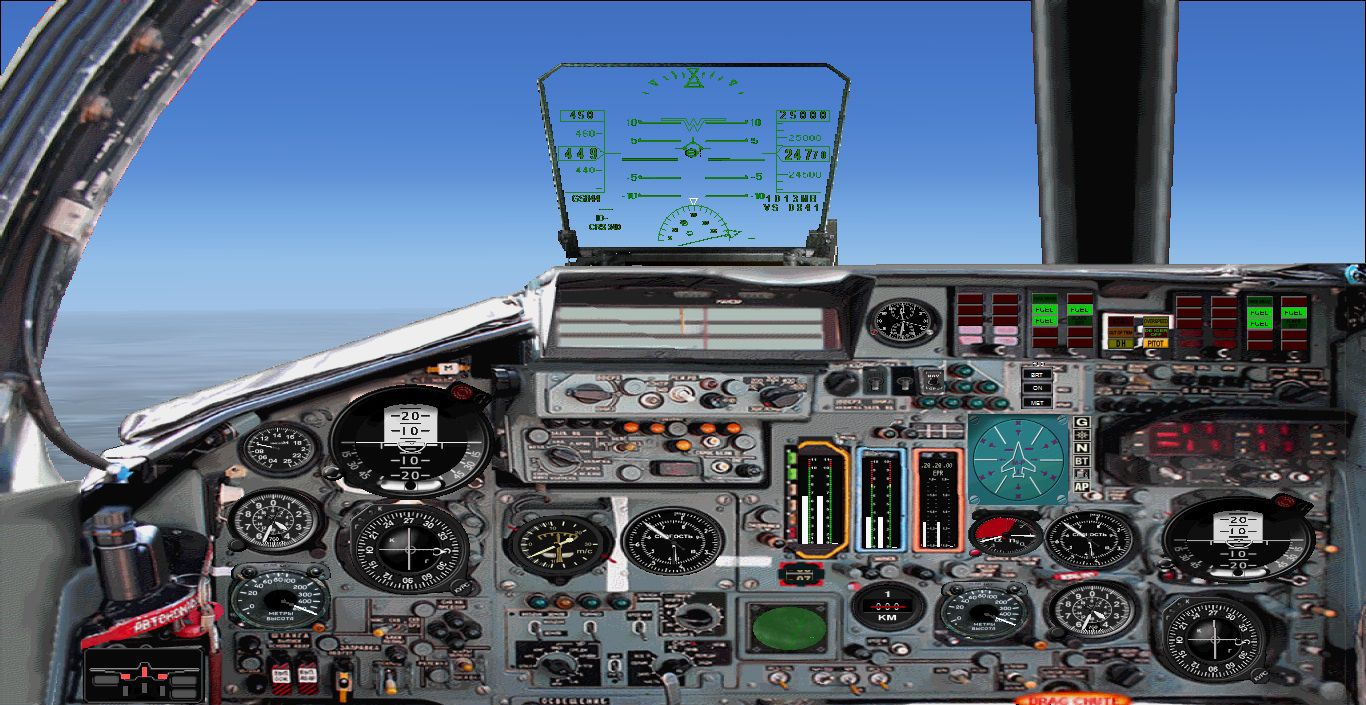
It remains in service with the Russian Air Force, Syrian Air Force, Ukrainian Air Force, Algerian Air Force and other air forces to which it was exported.
Wallpaper Su 24, Sukhoi, Fencer, Russian Tactical Bomber Images For Desktop, Section авиация
One of the conditions for the acceptance of the Sukhoi Su-7B into service in 1961 was the need for Sukhoi to develop various all-weather models suitable for precision air. Preliminary research on the S-28 and S-32 aircraft revealed that the Su-7's basic design was too small to contain all the avionics required for the mission.
He planned the development of a nav/attack, codenamed Leopard, which would be the centerpiece of the new aircraft.
That same year, the United States requested a new all-weather fighter jet, the TFX. Then the F-111 would introduce a different wing geometry to greatly increase payload, range, and low-flying capabilities.
In 1962-1963, Sukhoi began to develop an aircraft without the complex movement of wings like the F-111. He designed and built a toy S-6, a winged Delta Tumansky R-21 turbojet engine built by two and later repaired with a group of two. A mock-up was inspected but no further work was ordered due to the lack of progress on the Leopardus.
Su 24 (nato: Fencer)
In 1964, Sukhoi began work on the S-58M. The aircraft is supposed to represent a modification of the Sukhoi Su-15 interceptor (designation officinalis S-58). Meanwhile, revised Soviet Air Force requirements called for low-altitude strike aircraft capable of STOL. The most important feature is the ability to cruise at supersonic speeds at low altitude for extended periods of time to pass airspace runners.
To achieve this, the plan includes two Tumansky R-27 downsized turbojets for cruise and four Rybinsk RD-36-35 turbojets for STOL performance. The adjacent passenger seat was filled because Orion's large radar antenna required a large frontal section.
To test the six-engine scheme, the first Su-15 prototype was made into a flying laboratory S-58VD that operated in 1966-1969.

The ship was officially certified on August 24, 1965 under the code name T-6. The first prototype, the T-6-1, was completed in May 1967 and flew on July 2 with Vladimir Ilyushin at the helm.
Turkish F 16 Fighters Shadows Russian Su 24 Combat Jets
After completing initial flights without the four jets installed in October 1967, the R-27s were replaced at the same time by Lyulka AL-21Fs. STOL tests confirmed data from the S-58VD that achieved short field performance with a loss of significant flight distance as the gins occupied space normally reserved for fire, damage to the hard sub-fuselage, and instability when transitioning from STOL to conventional flight.
By 1967, the F-111 was in service, and demonstrated practical advantages and solutions to technical design problems. On August 7, 1968, the OKB officially researched a different wing geometry for the T-6. The resulting T-6-2I first flew on January 17, 1970 with Ilyushin at the controls. Subsequent government trials lasted until 1974, dictated by the complexity of the systems in the tables.
On Soviet attack aircraft - by attack system Puma nav/consists of two Orion-A superimposed radar scanners for nav/attack, a dedicated Relyef terrain clearance radar to provide control over wide flights at low and very low altitudes, and Orbit. Sails computer -10-58.
The crew is equipped with Zvezda K-36D ejection seats, which allow them to bail out from any altitude and flight speed, between takeoff and landing.
Sukhoi Su 24 Fencer, 73 White / 2615334, Vadim Zadorozhny Technical Museum
The resulting design, with a range of 3,000 kilometers (1,900 mi) and a payload of 8,000 kilograms (18,000 lb), was slightly smaller and shorter than the planned F-111.
Fatal accidents occurred during the development of the Su-24, which killed three Sukhoi and Soviet Air Force test pilots, and more than 5 crashes per year on average thereafter.
The first production aircraft flew on December 31, 1971 with V.T. Vylomov in command, and on February 4, 1975, the T-6 was formally accepted into service as the Su-24.
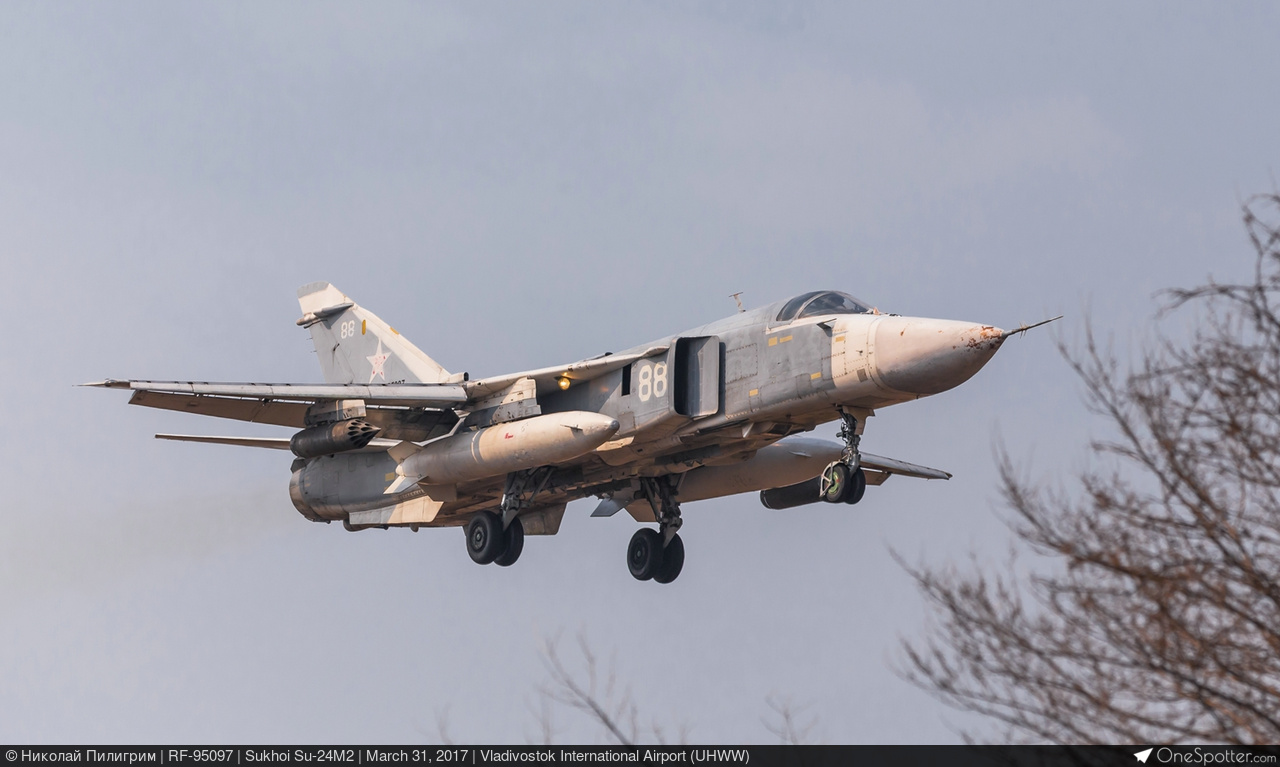
Surviving Su-24M models have gone through a decommissioning and modernization program, with GLONASS, an upgraded cockpit with multi-function displays (MFDs), TESTA, a digital moving map carrier, Shchel vision helmet, and provision for in the latest guide. weapons, including R-73 (AA-11 'Archer') air-to-air missiles. The upgraded aircraft was designated Su-24M2.
Su 24 Fencer
This section requires additional citations for validation. Please help make this article better by adding citations to specific sources. Undeveloped material can be attacked and removed. (February 2010)
The Su-24 has variable wing geometry with relatively small fixed wing flaps, trailing at 69°. The wing has four sweep settings: 16°for takeoff and takeoff, 35° and 45° for cruise at altitude difference, and 69° for minimum ratio and wing area at low impact levels. The variable geometry wing provides excellent STOL performance, reaching a cruising speed of 230 kilometers per hour (140 mph), less than the Sukhoi Su-17, despite carrying more weight. High horn loading provides a stable ride and minimal windage response.
The Su-24 has two Saturn/Lyulka AL-21F-3A afterburner turbojet engines of 109.8 kN (24,700 lbf) each, releasing air from two lateral rectangular flaps.
The initial Su-24 ("Fcer A" according to NATO) had these variable pitches, giving a maximum speed of 2,320 kilometers per hour (1,440 mph), Mach 2.18, at an altitude of 17.500 meters ( 57,400 feet). Since the Su-24 is used almost exclusively for low-level missions, the actuators for the thrust variants have been removed to reduce weight and maintenance. This has no effect at low levels, but absolute maximum speed and altitude are cut at Mach 1.35 and 11,000 meters (36,000 ft).
Image Of The Sukhoi Su 24 \
The first Su-24 had a box-like rear fuselage, which was soon changed in production to an exhaust tip that was more tightly shaped around the wings to reduce drag. The modified developer also got three fairings on the nose next to the antennas, a new broken tunnel, and a new ram inlet at the base of the tail fin. The recognized aircraft was named "Fcer-B" by NATO, but did not get a new Soviet designation.
Armamt Su-24 is equipped with one of the fastest guns GSh-6-23 with five hundred rounds, which is built under the fuselage. The gun is covered with a cap when not in use.
Early Su-24s had basic electronic measurement equipment (ECM), with many Su-24s limited to the old Sira-warning receiver without an integrated jamming system. Later-production Su-24s have more comprehensive radar warning, missile-launching, and effective ECM equipmt, with triangular antennas mounted on the sides and a vertical fin tip. It received the NATO designation "Fcer-C", although again it had no separate Soviet designation. Some "Fcer-C" and then Su-24M (NATO "Fcer-D") have a large wing fce/pylon in the wing group with an integral spoiler/flare; others have such feathers on either side of the tail fin.
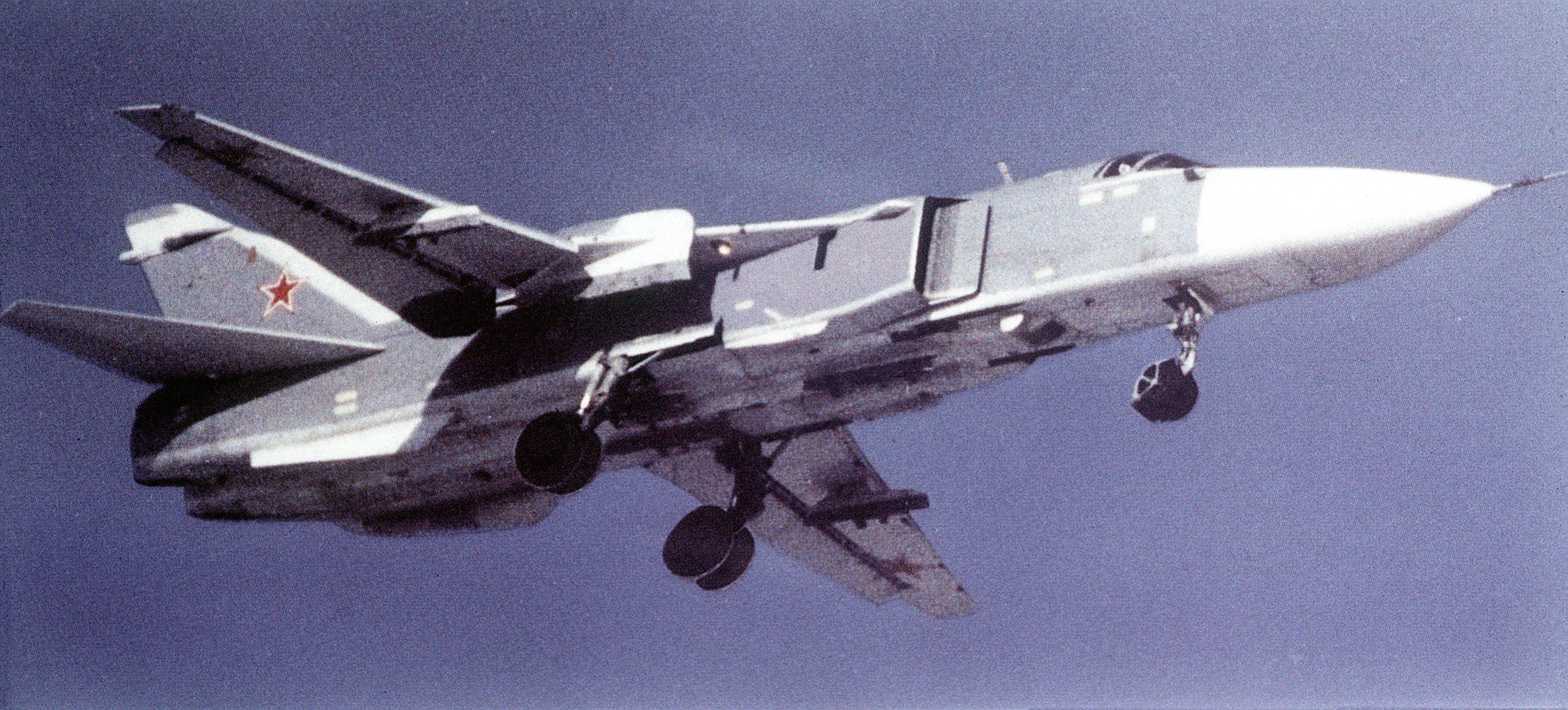
A large number of ex-Soviet Su-24s remain in service in Kazakhstan, Russia and Ukraine. As of 2008, approximately 415 were serving in the Russian Armed Forces, 321 in the Russian Air Force and 94 in the Russian Navy.
Russian Supplied, Mercenary Flown Su 24 Combat Jets Appear In Libyan National Army Video
The Soviet Union used several Su-24s in the Soviet-Afghan war, including the first strikes in 1984 and the second intervention of the war in 1988. No Su-24s were lost.
On October 13, 1990, the Syrian Air Force shot down a Lebanese plane to hit the military forces of General Michel Aoun. Sev Su-24s were used in this operation.
During Operation Desert Storm, the Iraqi Air Force flew 24 of its 30 Su-24MKs to Iran. Another five were destroyed on the ground, with one survivor remaining in service after the war.
Fcers were used by the Uzbek Air Force (UzAF) against the Tajik opposition operating from Afghanistan (which also had its own civil war), as part of a larger air campaign in support of the government of Tajikistan during the 1992-97 civil war. . war The Su-24M was shot down on 3 May 1993 with FIM-92 Stinger MANPADS fired by terrorists. The two crew members were rescued by the Russians.
Aircraft Photo Of 66 Red
In August 1999, Tajikistan protested an alleged strike by four UzAF Su-24s against Islamist militants in areas near two mountain villages in Jirgatol District which, although it caused no human casualties , killed hundreds of cattle and burned several plantations. Tashkt died of the charges.
During the latter part of the 1996-2001 civil war in Afghanistan, Uzbekistan sent air strikes against Taliban positions in support of the Northern Alliance. On a mission to attack a Taliban infantry unit near Heiratan, an UzAF Su-24 was shot down on June 6, 2001, killing both crew members.
On February 3rd
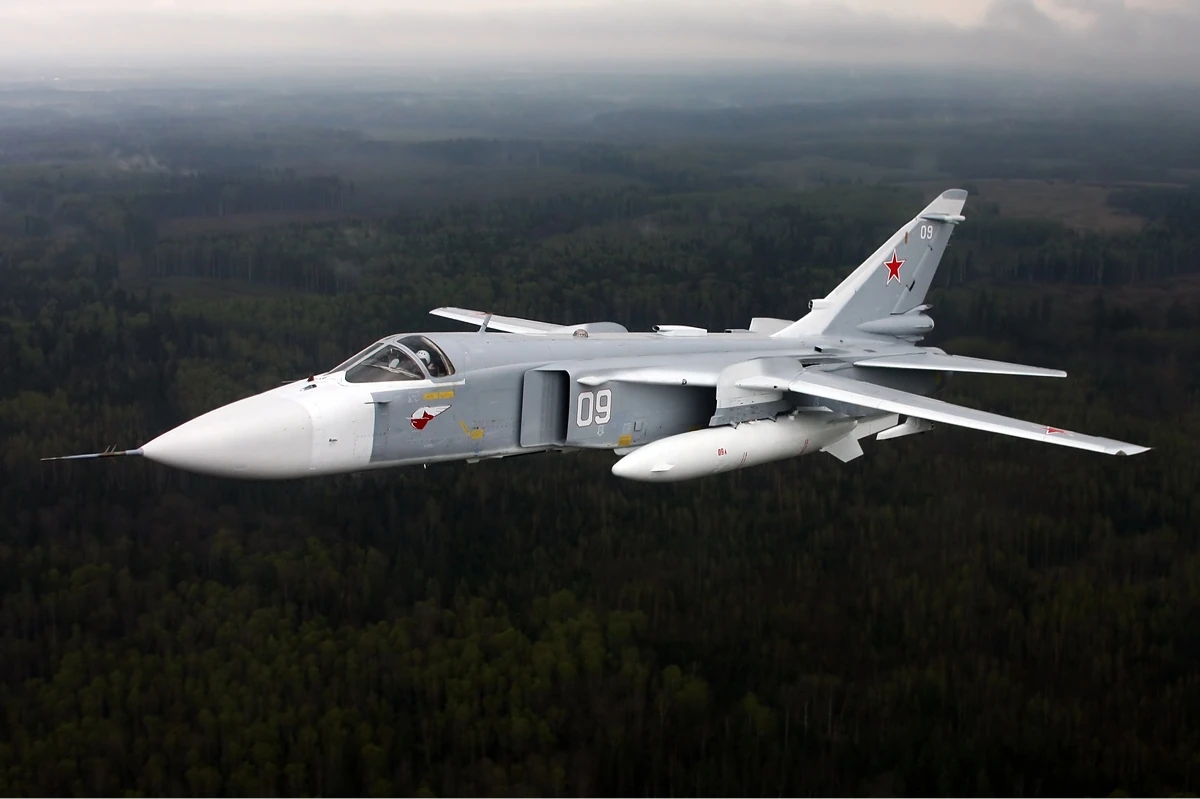
Su 24 fencer cockpit, su 24, sukhoi su 24 fencer, 1 48 su 24, sukhoi su 24, su-24 fencer, su 24m fencer d, su 24m fencer, thoi su 24 gio, russian su 24 fencer, su 24 for sale, su fencer
0 Comments