Small Shotgun Shell - That's all (at least the first half of everything) you should know and want to know about using bullets in a home defense shotgun. In this, the first of a two-part series, we cover topics from the absolute basics to some of the more obscure aspects of buckhot. Watch the video below for all the details or just scroll down to read the full transcript for sizing, swatches and more.
If you have a shotgun for home defense, it should probably be loaded with pellets. I've done a video before on how to choose a shotgun bullet for home defense, but that was almost five years ago and it was a little short. I wanted to come back to the topic and fill in some details that I left out earlier. This is going to be a pretty deep dive because balance is a surprisingly complex topic. There are many options and more than any other type of firearm, the choice of shotgun ammunition is critical to making sure the gun does what we want it to do.
Small Shotgun Shell

If you're looking at this because you just want a simple recommendation for putting your house gun inside, I'll save you the trouble of sitting through the whole thing. Just get a few boxes of Federal FliteControl 12 gauge 8-pellet #00. It works great in almost any shotgun and makes a big fist sized hole out to at least 10 yards. There are other good loads out there, but it's hard to go wrong with FliteControl. Now do me a favor and go buy one because my son is going to need braces soon.
Gauge Vs 410 Bore
Okay, if you're still with me, I guess that means you want to know more about the "why" behind this choice. So, I'm going to go over pretty much everything you might want to know about using a firearm for self-defense. I'm splitting this one into two videos. I have three main points to cover today, and I'll make three more in part two.
One last thing before we get into it. I don't usually do this, but there is one question that gets asked a lot and it is correct. "Who is this guy and why should I listen to anything he has to say? He looks like he might even be a vegetarian. What could he possibly know about guns?"
I actually wish people would ask this more often, especially when they get gun info from YouTube. I am nobody special. I am employed to provide useful (or at least entertaining) information for our customers and potential customers. To that end, I have completed approximately 700 hours of professional firearms training over the past several years. About 100 hours of that is shotgun training, including classes with Rob Haught, Darryl Bolke, Randy Cain, Tim Chandler, Ashton Ray, and the Rangemaster Shotgun Instructor Course with Tom Givens.
I certainly do not claim to speak for any of these instructors. I am aware that there will be room for disagreement with some of the ideas I will present. But I strongly believe in an evidence-based approach to studying these issues. So if I say something that sounds a little mean to you, I'm probably 100% wrong. But I hope you'll consider the fact that I probably didn't make that up. It's based on something I've noticed or something I've learned from people who have a lot more experience with these things than I do.
A Closer Look At Federal's New Short Shells
With that out of the way, let's start with the non-controversial stuff. The first thing you should know about buckshot is that there are many different types and not all are created equal. It probably goes without saying that you've been carrying guns for a while, but not everyone knows that. Buckshot varies in case length and the number, size and velocity of pellets in that case. Ammunition manufacturers also have a number of different methods of trying to control pattern spread, something we'll come back to in Part 2. First, let's break down these other attributes:
By the way, let's assume I'm talking about a 12 gauge here. There's nothing wrong with the 20 gauge in theory, but it only has a fraction of the market support of the 12 gauge. There aren't many self-defense loads that are purpose-built for the 20, so we're focusing on the 12 here.
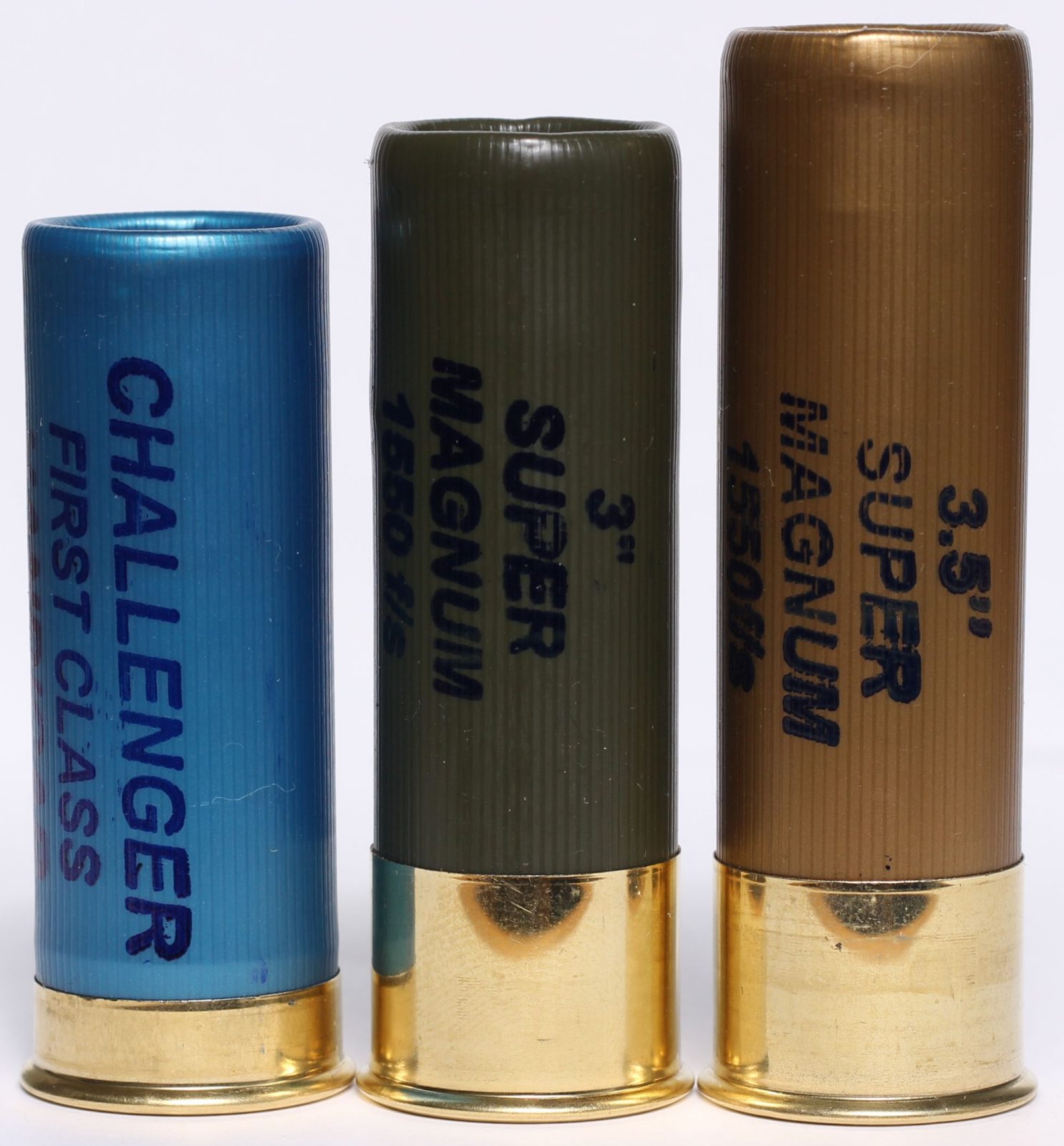
There are four common sizes: 2¾ inches, 3 inches, 3½ inches, and recently we've been seeing more 1¾ inch mini shells.

2¾ inch shells are standard. There is usually no good reason to use anything other than a 2¾-inch shell for self-defense against humans. They are sufficient for this job. Mini grenades do not fit in most shotguns. You can only use 3 and 3½ inch shells if your barrel specifically says it is for them. These longer shells will give you more speed or more balls. This can be useful for larger animals or to extend your reach, but for the average person it's not really necessary for personal protection in and around the house.
The 'shotgun Shell From Hell' Started As A Meme, Then Actually Got Tested At The Range
Shell length is determined by measuring the shell before it is folded. The shell loaded out of the box is slightly shorter. So if you take a 2¾ inch shell after firing it will be about 2¾ inches. When not on, it will be closer to 2¼ inches if it has a star curl. If rolled like this, it will be more than 2½ inches. This means that for some shotguns, you won't be able to fit as many rounds into the mag barrel if they are coiled. You might only get four shells in a five shot barrel. Most cartridges designed for self-defense are equipped with stars to increase your capacity.
The smallest shot is shot #4, not to be confused with shot #4, which is a bird shot. The largest I've heard of is #0000, but #000 is the largest common size. The most popular size by far is $00, especially for self-defense. It was the gold standard for law enforcement for many decades. Money #1 and #4 are also quite common. Each #00 pellet is about 0.33 inches in diameter. no. 1 is 0.30 inches and pellets no. 4 are 0.24 inches.
The number of pellets in each case varies depending on the size of the shot and the length of the case. 2¾ inch #00 shot comes with 8 or 9 balls. You will occasionally see a 12 pellet load. A #1 buck usually has 12 to 16 pellets. Number 4 will have between 21 and 28 pellets.
As I mentioned, some of the 3 and 3 ½ inch shells push pellets faster, but even among the 2 ¾ inch shells, velocity can vary quite a bit. For self-defense loads, this window is usually about 1100 to 1600 feet per second from the manufacturer's test barrel.
Qty 200 Empty Shotgun Shells Mixed Red Hulls Spent 12 Ga Casings Fired
So how much speed do you need for self-defense? Well, it depends. Loads of 1100 or 1200 feet per second are often labeled "low recoil" and are a little easier to control. The low recoil #00 buck has been very popular with law enforcement since the 80's or 90's and seems to be just as effective for close range encounters as higher velocity stuff. Just be aware that certain semi-auto shotguns do not perform reliably with light recoil loads.
At about 1100 to 1200 feet per second, the #00 will penetrate 18 to 20 inches of ballistic ice, which is more than enough. If you push those same #00 balls 33% faster at 1600 feet per second, you will likely end up with over penetration. They are also more likely to penetrate exterior walls and other hard barriers.
The #1 shot also works very well in this range of 1100-1200 feet per second. That's about 15-18 inches of gelatin, which means it's not very likely to go completely through a human target.
To be honest, shot no. 1 is actually more ideal than 00 from a ballistic standpoint. It has an equally good success rate with law enforcement. Unfortunately, number 1 is not that popular. Therefore, the demand in the market is low, which makes it difficult to find a good load with this size of shot.
Gamo Viper Express Exp20 Shot Shells
Buck #4 is where you might want a little extra speed. Each ball no. 4 has approximately half the mass of pellet no. 1. So if it moves at the same speed as no. 1, probably won't penetrate. Most #4 loads are more like 1300 or 1400 feet per second. Even then, they are on the verge of adequate penetration, at least anecdotally speaking. I've heard of many success stories with the #4, but I also know of a few stop failures that probably wouldn't have been failures with a #00 or #1 buck. At short range, inside the house with nothing between the gun and the threat is probably fine.
I could see #4
Shotgun shell shot glasses, shotgun shell vest, shotgun shell holster, shotgun shell urn, shotgun shell lights, shotgun shell trip alarm, shotgun shell sling, shotgun shell wallet, leather shotgun shell pouch, shotgun shell primers, shotgun shell thermos, shotgun shell pouch
0 Comments