St-21 Super Tomcat - If the Super Hornet hadn't been built, Grumman's next generation Tomcat might have been a reality. We have recreated it for imagination in these amazing interpretations.
Arguably America's most famous and beloved fighter jet, Grumman's F-14 Tomcat still holds the public in its grip more than a decade after it was retired from US Navy service. Among the many long-form, in-depth pieces I've posted on "Turkey Birds," one post from years ago still goes viral and is a source of regular reading -
St-21 Super Tomcat

Super Tomcat that was never built. It's been five years since I wrote that piece - the first iteration of it was almost a decade ago - and now, with the help of our favorite aviator Adam Burch of Hangar B Productions, we've recreated what the plane would have looked like. look alike. like it was built - like we did with the F-23 and F-32. Not only that, but we have also ventured to create a '2010s' development projection for this aircraft similar to what we have seen with Boeing's recent F-15 Strike Eagle models.
F 14 Attack Super Tomcat 21 [nenchi/sakkamoo]
So fasten your ejection seat straps, wipe down the controls, crank up and slide the salute as we launch you down the runway into some historic space.
We'll start with a little history about the Super Tomcat 21 from my previous piece. Some of the details and timing are disputed, but generally this is an idea of where ST21 came from:
In our reality, the F/A-18E/F Super Hornet became the Navy's vanguard fighter of the 21st century because of the boondoggle that was the A-12 Avenger program. After huge costs, weight increases and major delays, Defense Secretary Dick Cheney scrapped the fighter jet, leaving a huge hole in NAVAIR's future.
It was 1991, the Cold War had just ended and we had just finished kicking the ass of one of the largest standing armies in the world. Congress had been told to implement high-risk, aggressive defense programs for decades, and they had had enough. "Peace Dividend" sentiment was rising and defense budgets were beginning to shrink.
Super Tomcat 21: O Plano Da Us Navy Para Um “f 14 Tomcat Com Esteroides”
With the A-6E TRAM Intruder's retirement and in the vacuum created by the canceled A-12 program, manufacturers are starting to throw out "reasonable growth" designs based on existing platforms [some have already been revised and improved concepts from previous years]. The hope was that if the aircraft manufacturers made almost a new aircraft that looks like an existing model, giving them "evolutionary" information, Congress would see the product as a cheap, expensive upgrade to an established one and therefore go ahead with the purchase.
At the same time, the NATF program (the Navy's equivalent of the USAF's Advanced Tactical Fighter program) was underway, but the cost and time of its development would have been enormous, and looking at what happened to the stolen A-12 "Flying. Dorito," it was clear that something simpler was needed . Ultimately, this "low risk" and common design concept worked its way through the final development and procurement of the F/A-18E/F Super Hornet. But in some people's opinion, it worked for the wrong plane.
The Super Tomcat 21 grew out of a proposal made by Grumman after the collapse of the A-12 program called Quick Strike [one of my sources says it came before Quick Strike, but was revised later]. Fast Strike would be an upgrade to the existing F-14s by giving them a way to navigate and target pods similar to the USAF's LANTIRN system, as well as upgraded ground attack systems F-14D's APG-71 Radar (based on the original aircraft AWG. - 9 radar) and the ability to carry additional weapons such as AGM-84E SLAM and AGM-88 HARM.
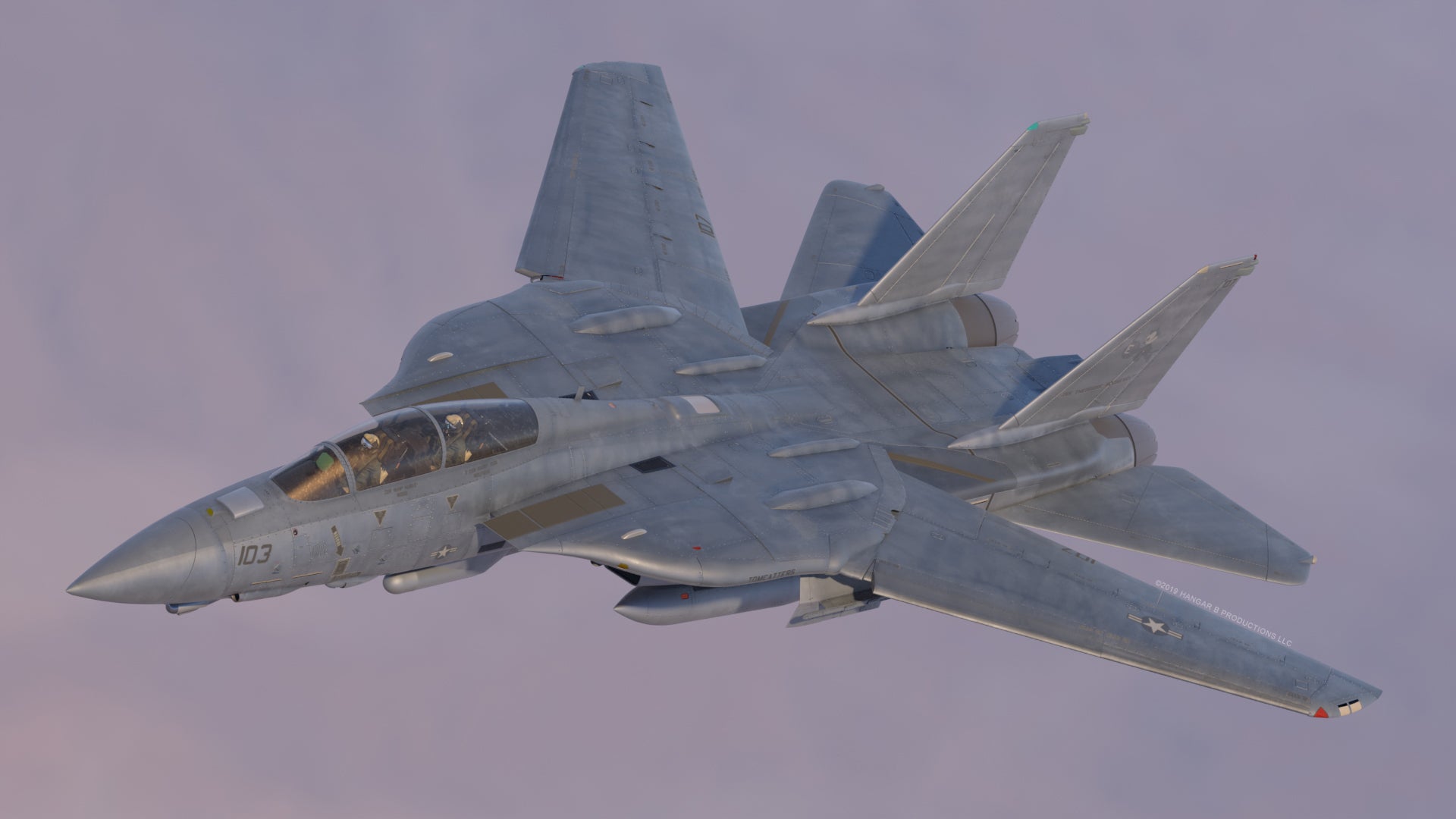
Aimed at cheaply picking up the Intruder's slack rather than replacing the A-12's advanced capabilities, the Quick Strike was seen at the time as a sufficient technological leap over the F-14B and D models already in service. Also, rumors that a cheaper, cleaner next-generation Hornet design was in the works at McDonnell Douglas didn't help the Quick Strike proposal. So Grumman returned to the fleet with a real "Super Tomcat", called the Super Tomcat 21 [ST21].
F 14d Super Tomcat
As mentioned above, this also happened at the same time that it became clear that NATF was not going to happen. So while the Quick Strike could help fill the gap left by the intruder, the ST21 could close that gap and the gap left by the NATF, performing its intended function, even without the benefit of hacking and many other cutting, high-risk machines.
The Super Tomcat 21 would include a number of improvements over the F-14D, and could be produced by redesigning existing F-14 airframes, or could be ordered through a new build system. Perhaps a combination of both options could have been used, like the F-14D. Keep in mind that the last new-build Tomcat had rolled off the Bethpage, New York production line in 1992, so it's not like the F-14 was long in the tooth or its production line went cold for a long time when the Super Tomcat 21 was considered.
Grumman F-14 Super Tomcat 21 model. It now hangs in the Cradle Of Aviation Museum in Garden City, NY. The provided general scheme of ST21., Public Domain via "GE Geoff"
ST21 would have included many sensible features that would highlight Tomcat's capabilities and minimize its flaws. These were very available or advanced technologies. As a result, Grumman could start producing ST21s as early as the mid-1990s.
F 14d 170 Gr Super Tomcat Fighter Squadron 213 Black
Many of the less common ones may also be included. These include improved hydraulic and environmental control systems and minor changes to the Tomcat's flight controls and aerodynamics to improve performance, stability and safety. The ST21's weight gain would also have increased, which may have resulted in a slight improvement to its already heavy landing gear. The F-14D's radar warning and electronic countermeasures suite could have continued with some minor improvements, but that would have been a focus for future upgrades, which we'll get to in a moment.
All in all, the ST21 would have been a powerful beast for a multi-tasking fighter. With the increase in the amount of oil, both inside and outside, its volume and duration of instability would have increased significantly. Combined with supercruise in an air-to-air attack configuration, AIM-120 capability and the latest infrared search and track (IRST) system and an improved television camera set (TCS) carried over from the F-14D, the ST21 would have pushed the Tomcat into new realms with fighters and naval defenders . In fact, no other fighter in the world would have had nearly the same long-range target detection and identification capabilities.
The upgrades to its engines, slats, digital flight control system, windshield and HUD, as well as minor tweaks to other control areas, including its spoilers, would have made it a more formidable close-dog. The nav/attack pod setup would have provided a deep-climb, all-weather deep attack capability, like the F-15E. The inclusion of stand-off weapons would have dramatically increased the carrier's capabilities, and these new weapons would have been a perfect match for carrying the heavy load of the Tomcat. It may have even seen the AIM-54 Phoenix long-range air-to-air missile being upgraded again and remain active for longer to take advantage of the ST21's large powerful sensor suite.

Indeed, the ST21 represents what many always dreamed the Tomcat could be, keeping its capabilities rooted in the simplest technology of the time. In many ways, the technology would have caught up with the Tomcat's airframe design. The ST21 configuration leaves plenty of room for future upgrades that can take over and push the versatility to another level.
F 14(st 21) Super Tomcat Nico Yazawa By Pak Faace1234 On Deviantart
In the early 1990s, another major upgrade of the Tomcat was launched as part of Grumman's future strategy that did not include the NATF - Advanced Strike Fighter 14 (ASF-14). The aircraft would have been a re-engineered Tomcat, using advanced technologies from the NATF program. This would be an expensive new build, probably more than what McDonnell Douglas did with their Super Hornet offering.
In fact, a follow-up to the ST21 in the form of the ASF-14 was not possible, although the ST21 would have been available. However, if the Navy had invested heavily back into the Tomcat platform in the form of the ST21 in the mid-1990s, the aircraft would have seen a mid-tech upgrade similar to the same technology that Boeing introduced. its F-15 line through the F-15SA as well as the F-15QA and F-15X, to a lesser extent. This would likely involve upgrading existing ST21 airframes with new technologies in a cost-effective manner.
Based on this assumption, we actually, logically and rationally collect what
Imc 21 m st, tomcat 21, 21 west st nyc, 21 broad st nantucket, 21 india st brooklyn, attack super tomcat 21, super tomcat, 21 st anniversary gift, super tomcat 21, f 21 super tomcat, f 14 super tomcat 21, truck lite super 21
0 Comments